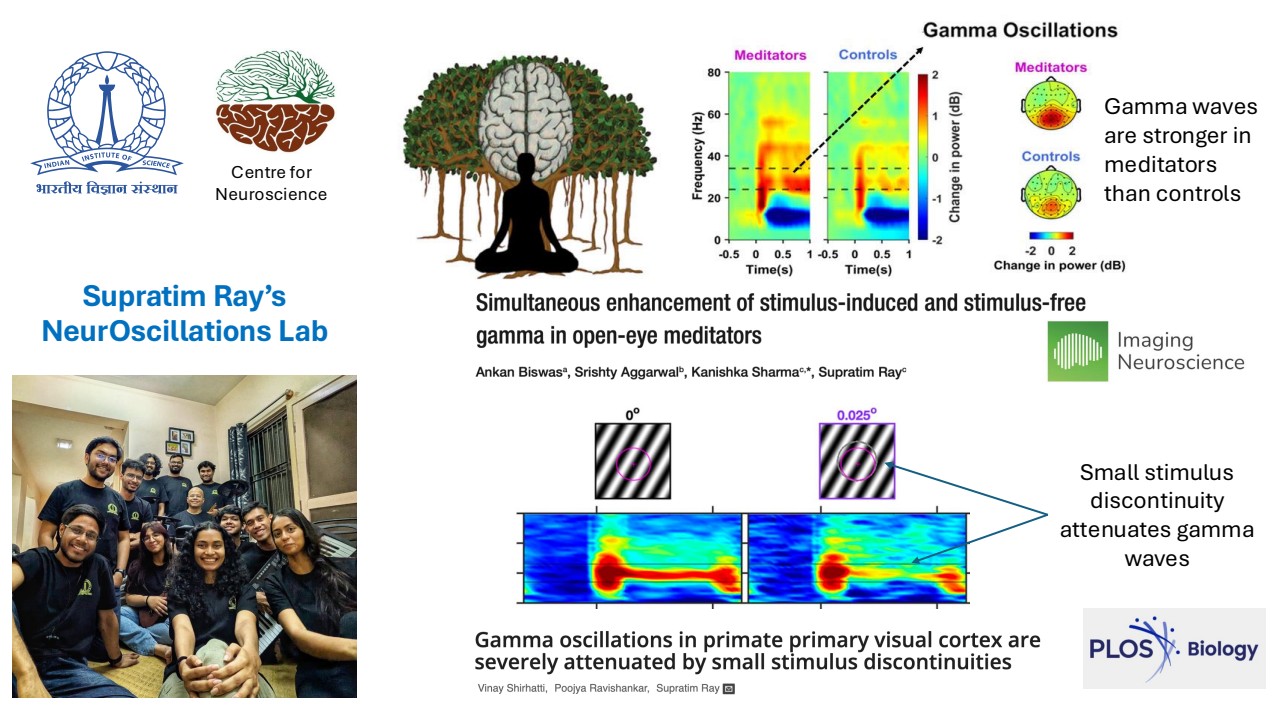
Prof. Supratim Ray’s lab studies the neural basis of high-level cognition such as selective attention and meditation, with a focus on a brain rhythm called “gamma” (30-80 Hz), which is thought to be associated with high-level cognitive processes. Top: Gamma oscillations, which attenuate with heathy ageing and onset of mental disorders, are stronger in long-term meditators than age/gender matched controls, suggesting a potentially neuroprotective role of meditation. Bottom: These gamma oscillations are also highly attenuated by small stimulus discontinuities, which is explained by a finely tuned excitation-inhibition (E-I) circuit, suggesting a link between gamma and E-I balance in the brain.
Faculty: Supratim Ray
References: Biswas A, Aggarwal S, Sharma K and Ray S† (2026) Simultaneous enhancement of stimulus-induced and stimulus-free gamma in open-eye meditators. Imaging Neuroscience. 4: IMAG.a.1145
Shirhatti V, Ravishankar P and Ray S† (2022) Gamma oscillations in primate primary visual cortex are severely attenuated by small stimulus discontinuities. PLoS Biology. 20(6):e3001666.
For More:https://www.iisc.ac.in/meditation-strengthens-gamma-oscillations-in-the-brain/