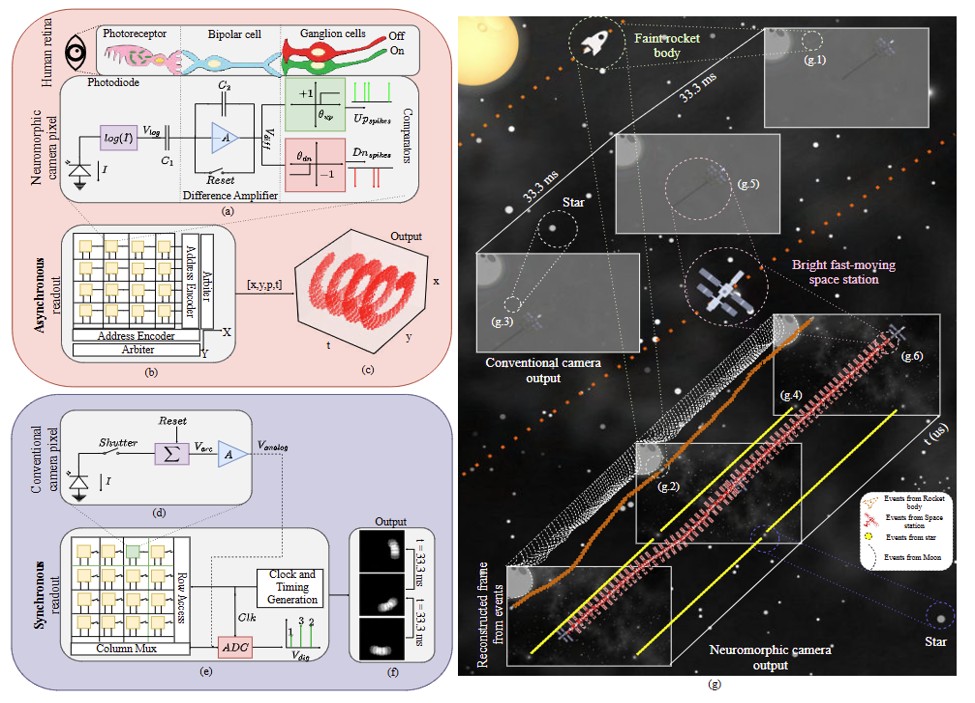
Working principles of neuromorphic and conventional cameras. (a) Structure of a neuromorphic camera pixel, with components analogous to the human retina: a photodiode (photoreceptor), difference amplifier (bipolar cells), and comparators (on-off ganglion cells), including the transformation of light intensity into the logarithmic domain and the spike generation process. (b) Asynchronous data transmission in the neuromorphic camera using AER readout. (c) The high temporal resolution of the neuromorphic camera enables tracking of the fast-rotating dot without motion blur. (d) Conventional camera pixel components: photodiode, charge storage, shutter switch, and gain unit. (e) Conventional camera workflow showing digital conversion by the ADC and frame generation. (f) Example of a fast-rotating dot in a static background. Frame generation at 30fps leads to motion blur. (g) Illustration of a full moon night sky showcasing the neuromorphic camera’s ability to capture faint objects like rocket debris and dim stars with minimal interference from bright moonlight and accurately tracking the fast-moving space station. In contrast, the conventional camera’s output is significantly impacted by intense moonlight and motion blur, obscuring faint objects and blurring the space station.
Faculty : Chetan Singh Thakur & Chandra Sekhar Seelamantula
References:S. S. Yadav, A. V. P, A. MD, C. S. Seelamantula and C. S. Thakur, “Asynchronous High-Speed Tracking of Astronomical Objects Using Neuromorphic Camera for Edge Computing,” ICASSP 2026 – 2026 IEEE International Conference on Acoustics, Speech and Signal Processing (ICASSP), Barcelona, Spain, 2026, pp. 19517-19521, doi: 10.1109/ICASSP55912.2026.11460932.
For More : https://labs.dese.iisc.ac.in/neuronics/event-based-sensing/